Bulk Data Cleaning
When a Large Database Starts Losing Leads
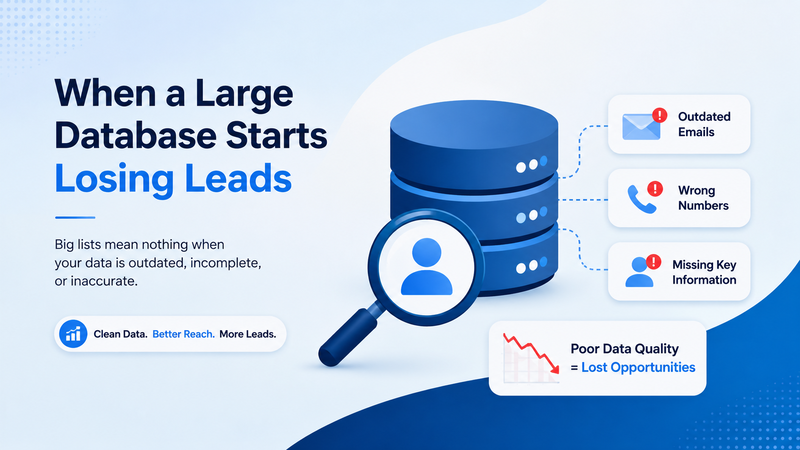
A large B2B database may look like a valuable sales asset, but size alone does not guarantee better results. As databases grow, duplicate records, outdated contact details, missing information, and inaccurate records can quietly reduce the number of leads sales teams can actually use.
Instead of helping sales representatives find more prospects, an unmanaged database can create more manual work, lower email engagement, and cause valuable opportunities to disappear. The good news is that businesses can recover much of this lost value through structured bulk data cleaning and regular database maintenance.
How Growing Databases Can Quietly Start Losing Valuable Leads
B2B databases naturally change over time. Employees change jobs, companies relocate, departments restructure, and contact information becomes outdated. When new records are continuously added without reviewing existing data, these changes can remain hidden.
A database with thousands or millions of contacts may therefore contain far fewer usable prospects than its total record count suggests. Sales teams may spend hours searching, checking, and correcting records instead of engaging with qualified buyers.
This is why businesses need to evaluate data quality, not simply database size.
How Duplicate Records Cause Sales Teams to Miss High-Value Prospects
Duplicate records are one of the most common problems in large databases. The same decision-maker may appear multiple times because of different spellings, job titles, email addresses, or company information.
These duplicates can create several problems. Sales representatives may contact the same prospect repeatedly, while another valuable prospect receives no outreach at all. Duplicate accounts can also distort reporting and make it difficult to determine how many unique opportunities actually exist.
Effective bulk data cleaning services can identify and consolidate duplicate records so sales teams can work from a more reliable prospect pool.
How Outdated Contact Information Turns Active Leads Into Lost Opportunities
A prospect who was highly relevant six months ago may still be valuable today, but their contact information may no longer be accurate. People change positions, companies, email addresses, and responsibilities frequently.
When sales teams rely on outdated information, emails can bounce, calls can reach the wrong person, and important decision-makers can be missed completely.
Regular data verification helps identify outdated records and gives businesses an opportunity to refresh important contact details before those prospects disappear from active sales campaigns.
How Inaccurate Lead Data Reduces Email Engagement and Sales Responses
Email campaigns depend heavily on accurate prospect information. If names, job titles, company details, or email addresses are incorrect, personalization becomes difficult and messages may reach irrelevant recipients.
Poor-quality data can also increase bounce rates and reduce campaign performance. Sales teams may then assume their messaging is ineffective when the real problem is inaccurate targeting.
Maintaining clean business data helps businesses improve targeting and gives sales teams a stronger foundation for personalized outreach.
How Data Gaps Make It Harder to Identify and Reach Decision-Makers
Missing data can be just as damaging as incorrect data. A database may contain a company name and general email address but lack the decision-maker's name, job title, direct contact information, or department.
These gaps make it harder for sales representatives to identify who actually influences purchasing decisions. Instead of reaching the right person directly, teams may spend time searching for additional information.
Filling important data gaps allows sales teams to prioritize the right contacts and reduce unnecessary research time.
How CRM Data Cleaning Helps Recover Leads Hidden Inside Large Databases
CRM systems often contain years of accumulated records. Some may be duplicates, incomplete, outdated, or incorrectly categorized. Without proper cleaning, these records can remain buried inside the system.
Database cleaning brings structure back to this information by identifying problematic records, standardizing fields, removing unnecessary duplicates, and highlighting data that needs verification.
The objective is not simply to reduce the number of records. It is to make the remaining database more useful for sales and marketing teams.
How Data Verification Helps Sales Teams Reconnect With Valuable Prospects
After identifying problematic records, businesses can verify important contact and company information. This process helps determine which prospects are still relevant and which records require updating or removal.
Verified information gives sales representatives greater confidence when launching outreach campaigns. It can also help businesses revisit older prospects that were previously ignored because their information was incomplete or unreliable.
In this way, data verification can turn overlooked database records into potential sales opportunities again.
How Clean Lead Data Improves Sales Productivity and Conversion Rates
Sales productivity depends on how quickly representatives can identify and contact qualified prospects. When salespeople spend less time fixing records, they have more time for conversations, follow-ups, and relationship building.
Clean data can also improve segmentation and personalization. Teams can organize prospects by industry, company size, job role, location, or other relevant criteria and create more targeted campaigns.
Better targeting does not guarantee conversions, but it gives sales teams a much stronger starting point for generating qualified opportunities.
How LeadsCampaign Helps Businesses Recover Lost Opportunities From Large Databases
LeadsCampaign helps businesses improve the usability of large B2B databases through structured data cleaning and verification processes. Instead of allowing duplicate, outdated, or incomplete records to continue affecting sales operations, businesses can identify and address data quality issues at scale.
With professional database cleaning, companies can organize their existing data, reduce unnecessary records, improve consistency, and make valuable prospects easier for sales teams to identify.
This can be especially useful for organizations managing large CRM systems, prospect databases, customer lists, or multiple data sources.
How Regular Database Maintenance Prevents Valuable Leads From Disappearing
Database cleaning should not be treated as a one-time project. B2B data continues to change, meaning even a clean database can gradually become outdated.
Businesses can establish regular maintenance schedules to identify duplicates, verify contact information, update company details, and address missing fields. Monitoring data quality continuously prevents small problems from becoming large-scale database issues.
The result is a sales database that remains easier to search, segment, manage, and use.
Conclusion
A large database is only valuable when sales teams can trust and use the information inside it. Duplicate records, outdated contacts, inaccurate information, and missing data can quietly turn a valuable prospect database into a source of wasted sales time.
Through regular bulk data cleaning, verification, and database maintenance, businesses can recover overlooked prospects, improve targeting, and help sales representatives focus on opportunities instead of data problems.
The goal is not simply to maintain a large database. It is to maintain a database that consistently supports sales growth.
FAQs
1. Why do large B2B databases lose leads?
Large databases can lose usable leads because of duplicate records, outdated contact details, inaccurate information, and missing decision-maker data.
2. How does database cleaning help sales teams?
Database cleaning removes or corrects problematic records, making it easier for sales teams to find relevant prospects and spend less time fixing data.
3. Can outdated leads be recovered?
Yes. Older leads can often be recovered by verifying contact information, updating company details, and identifying whether the prospect is still relevant.
4. How often should a B2B database be cleaned?
The ideal frequency depends on database size, industry, and how quickly contact information changes. Regular reviews are generally better than waiting until data quality becomes a major problem.
5. What is bulk data cleaning?
Bulk data cleaning involves reviewing and improving large volumes of business records to identify duplicates, outdated information, inconsistencies, and other data-quality problems.
6. Why is clean business data important for B2B prospecting?
Clean business data helps sales and marketing teams target the right companies and decision-makers while reducing wasted outreach, manual research, and inaccurate campaign reporting.
Comments
No comments yet. Be the first to comment!